Digital architecture: what it means in practice for a Swiss SME
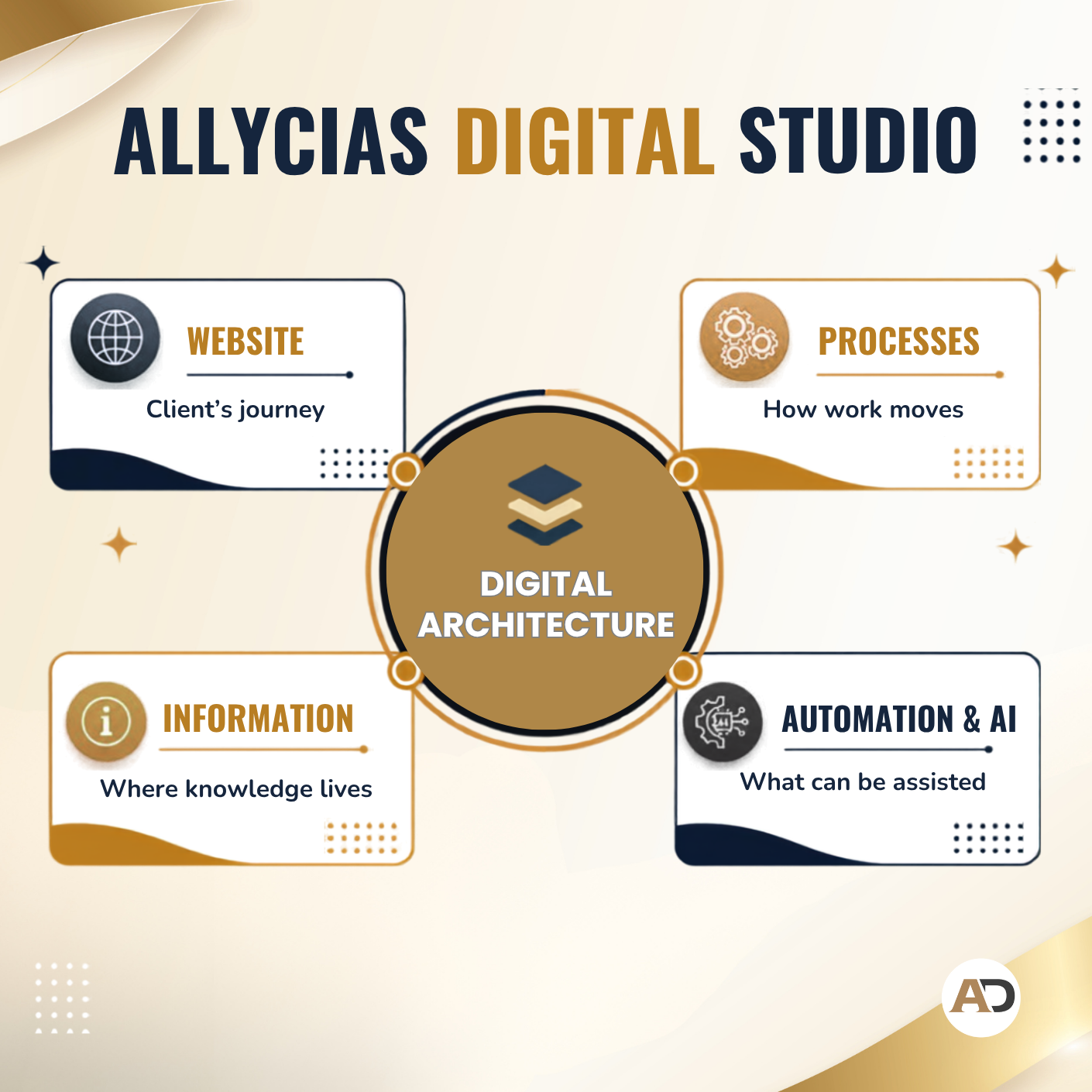
Digital architecture organises a company’s websites, tools, information and processes so they work together as a coherent system. This article explains what that means in practice for a Swiss SME.
A business may have a professional website, a booking platform, an invoicing solution, several forms and different internal applications. Its digital operations can still be difficult to manage.
The difficulty often lies in the gaps between these tools.
A request received through the website may need to be copied manually into another system. Important information may exist in several documents. Follow-up may depend on one person remembering what needs to happen next. The website may present the business professionally without properly supporting enquiries or the operations that follow.
Digital architecture examines this environment as a whole. It helps a business understand how its website, tools, information and processes should work together.
For an SME, this approach primarily brings clarity.
What is digital architecture?
Digital architecture is the structure connecting the different digital parts of a business.
This may include:
- The website
- Contact forms
- Booking systems
- Customer relationship management tools
- Document storage
- Invoicing solutions
- Communication platforms
- Automations
- Artificial intelligence tools
- The internal processes that allow these elements to function
Each tool may perform its individual role correctly. The quality of the overall environment depends on how these elements communicate, how information moves between them and whether responsibilities are clearly defined.
A coherent digital architecture answers four important questions:
- Where does information enter the business?
- Where should that information be recorded?
- Who needs to act, and at what stage?
- Which steps could be simplified or automated?
These questions help transform a collection of tools into an organised system.
Why do digital environments become fragmented?
Fragmentation usually develops gradually.
A business begins with a website and an email address. It later adds a form, a booking calendar, cloud storage, accounting software or a management platform. Each addition responds to a genuine need at the time.
As the business develops, several difficulties may appear:
- The same information is recorded in different places.
- Certain steps still rely on manual transfers.
- Tools overlap without clearly defined roles.
- Team members use different working methods.
- The website develops separately from internal operations.
- Decisions depend on information stored across several systems.
- New technologies are introduced without a clear framework.
The business may then assume that another tool is required. In some situations, the real priority is to organise the existing environment more effectively.
The website as part of the business infrastructure
A website is often the first point of contact between a business and a prospective client. Its role can extend beyond presenting services.
When properly integrated into the wider digital architecture, a website can:
- Guide visitors towards the appropriate action.
- Collect the necessary information from the first contact.
- Direct an enquiry to the right person.
- Trigger a confirmation or follow-up step.
- Make appointments easier to book.
- Answer recurring questions.
- Feed information into an internal system without repeated data entry.
Consider a healthcare practice that receives enquiries through its website. If the form collects too little information, the team must send several messages before understanding the person’s needs. If all enquiries arrive in a general inbox, assigning and following them may also become difficult.
A focused improvement to the form and its follow-up process could provide more value than a complete visual redesign.
The aim is to make the website an active part of how the business operates.
The four layers of a coherent digital architecture
A digital architecture can be examined through four connected layers.
1. The external experience
This layer concerns how clients discover and interact with the business.
It includes:
- Search visibility
- Clarity of positioning
- Website navigation
- Calls to action
- Forms
- Booking
- Practical information
- Continuity between the website and other channels
The journey should help someone understand the business, decide whether its services are relevant and know what to do next.
2. Internal processes
This layer begins when an enquiry, appointment or order enters the business.
It examines:
- How the request is received
- How it is assigned
- Where it is recorded
- How it is followed up
- Which approvals are required
- How the team communicates
- How the process is completed
A clear external journey loses part of its value if the internal process remains confusing or entirely manual.
3. Information
Businesses create and use many forms of information, including contact details, requests, documents, decisions, content, commercial data and procedures.
A structured architecture defines:
- Where each type of information should be stored
- Which version is authoritative
- Who can view or modify it
- How long it should be retained
- How it moves between tools
This organisation reduces duplication and makes it easier for work to continue consistently.
4. Automation and intelligence
Automation and AI become useful when the underlying process is sufficiently clear.
They may support:
- Sending confirmations
- Transferring information between tools
- Preparing summaries
- Categorising requests
- Creating reminders
- Preparing documents
- Identifying situations requiring human attention
Useful automation is built on a defined process, reliable information and clear human responsibility.
Would you like to examine these four layers within your own environment? That is what the Digital Architecture Lab™ is designed for.
What does a practical improvement look like?
Improving a digital environment does not always require rebuilding everything.
Depending on the situation, an improvement could involve:
- Restructuring a service page to make enquiries easier
- Improving a form so it collects the right information
- Centralising enquiries in one tracking system
- Creating a follow-up process
- Organising documents and responsibilities
- Connecting a booking system to an internal workflow
- Automating a clearly defined repetitive task
- Documenting a process so it can be followed consistently
- Introducing one specific use of AI into an existing workflow
The priority should be determined by the point of friction that has the greatest effect on operations or the client journey.
Where should an SME begin?
An SME can begin by examining one important journey from its starting point through to completion.
This might be:
- A contact enquiry
- An appointment booking
- A new client onboarding process
- An order
- A quotation request
- The preparation of a document
- The management of an internal task
For that journey, it is useful to document:
- The different steps involved.
- The tools used at each stage.
- The information required.
- The people responsible.
- The actions still performed manually.
- The places where an error, delay or omission could occur.
This exercise often reveals that a problem described as technical is also connected to how the process has been structured.
A structure adapted to the business
There is no single digital architecture that suits every SME.
A healthcare practice, an online store, a nonprofit organisation and a professional-services firm have different obligations, client journeys and internal requirements.
The solution should reflect:
- The size of the team
- The volume of enquiries
- The industry
- The tools already in use
- Internal responsibilities
- The company’s level of digital maturity
- Privacy and confidentiality requirements
- Development objectives
A simple and appropriately designed structure can be more effective than a sophisticated system that is difficult to maintain.
Building progressively
Digital architecture does not necessarily require a long or complex transformation project.
It can begin with an assessment of the existing environment, followed by one clearly defined priority improvement. This first intervention can resolve an immediate point of friction, provide practical evidence and help determine the next step.
The work should follow a logical order:
- Understand the current operation.
- Identify the priority point of friction.
- Define the required improvement.
- Select or adapt the necessary tools.
- Implement the solution.
- Test it under real working conditions.
This progression allows the business to develop its digital environment without adding unnecessary complexity.
Conclusion
Digital architecture gives an SME a structured view of its digital environment.
It clarifies how the website, tools, information and processes support the business together. It also makes it easier to identify which points of friction require attention first.
The starting point is the company’s real operation: how requests arrive, how information moves, where follow-up slows down and which actions are unnecessarily repetitive.
With this understanding, the business can introduce improvements that are precise, appropriate and able to develop with the organisation. You can also discuss this during a strategy consultation.
Does your digital environment support your business effectively?
The Allycias Digital Growth Assessment™ helps you identify the strengths, points of friction and improvement opportunities within your digital environment.
Are you developing a new project or reorganising an existing digital environment? Explore the Digital Architecture Lab™.
For a practical implementation method, read our guide next: Automation: where to start in a Swiss SME
Author
Alice Bourassin
Founder and Digital Systems & Workflow Strategist at Allycias Digital Studio
Alice Bourassin designs digital architecture for Swiss and European businesses: structure, clarity and systems that genuinely support how an organisation operates.
View author pageRelated articles
Automation: where to start in a Swiss SME
Automation is not about adding tools. It is about removing unnecessary repetition from a process you already understand.